
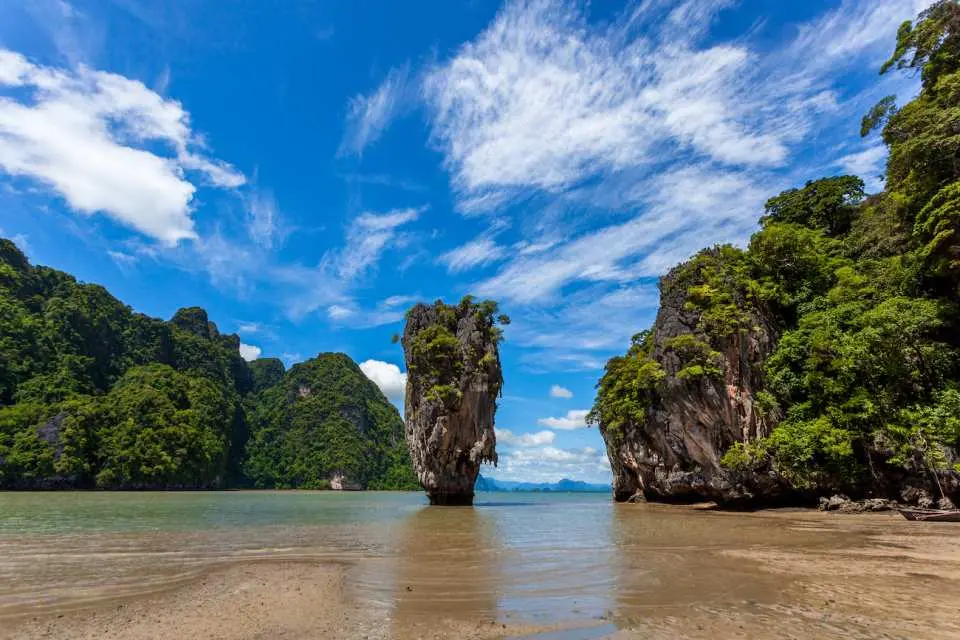
Ko Tapu – The Nail Rock of James Bond Island
Ko Tapu is the famous needle‑shaped limestone sea stack that appears in the 1974 James Bond film The Man with the Golden Gun. It stands about 20 metres tall, rising sharply from the emerald waters of Phang Nga Bay. Most people call the whole area James Bond Island, but the true name of the nail rock is Ko Tapu. This page gives you the real facts – no movie magic, just honest information for travellers.
🎬 Want to see Ko Tapu in person? 🎬
Join our small‑group tours to Phang Nga Bay. We stop right in front of the famous nail rock for the best photo angles.
🚤 Book Your Ko Tapu Tour →✓ Best price guarantee ✓ Professional guides ✓ Hotel pickup
Where Is Ko Tapu?
Ko Tapu is located in Phang Nga Bay, about 25 kilometres north‑east of Phuket. Its exact coordinates are 8°16′N 98°30′E. It sits just 40 metres away from the larger island Khao Phing Kan (the real James Bond Island). The rock is inside Ao Phang Nga National Park, which was established in 1981. The park covers 400 square kilometres and includes more than 40 limestone islands.
Visitors can only reach Ko Tapu by boat – no road, no bridge. Most tours from Phuket or Krabi include a stop in front of the rock. You cannot land on Ko Tapu itself. Boats anchor nearby, and you take photos from the boat or from the beach of Khao Phing Kan. The rock is too steep and fragile for landing.
What Does “Ko Tapu” Mean?
In the Thai language, “Ko” (เกาะ) means island. “Tapu” (ตะปู) means nail. So Ko Tapu translates to “Nail Island”. The name comes from its shape – a tall, thin column of limestone that looks exactly like a giant rusty nail hammered into the seabed. Local fishermen have used this name for generations, long before the James Bond film arrived.
Many visitors mistakenly call it “James Bond Rock” or “Khao Phing Kan”. But locals make a clear difference: Khao Phing Kan is the twin‑hill island; Ko Tapu is the separate nail‑shaped sea stack. Both together form the iconic view seen in the movie. When you look at the famous scene from The Man with the Golden Gun, the tall thin rock is Ko Tapu; the background cliffs are Khao Phing Kan.
Geology: How Ko Tapu Formed
Ko Tapu is a classic example of a sea stack. It began as part of a larger limestone cliff attached to Khao Phing Kan. The limestone itself formed 295 to 250 million years ago during the Permian Period, from the shells and skeletons of ancient marine creatures. Later, tectonic forces lifted the rock above the sea. Then, for millions of years, waves and rain slowly eroded the softer parts of the cliff, leaving behind a resistant pillar. This process is called “differential erosion”.
The result is a slender tower about 20 metres high (66 feet) and only 8 metres wide at its base. Its sides are nearly vertical, with a slightly pointed top that gives it the nail appearance. The rock is grey‑white, with many small holes and crevices where birds and bats nest. Because it is entirely surrounded by water, the base is undercut by wave action – a typical feature of sea stacks. Geologists believe Ko Tapu will eventually collapse, but that will take thousands of years. For now, it remains one of the most photographed rocks in Thailand.
Visitors must never try to approach or touch the rock. Boats are not allowed to tie up to it. The national park strictly enforces a 10‑metre buffer zone to prevent damage and accidents. Falling rocks are a real danger – small pieces break off naturally.
Film History: Ko Tapu in The Man with the Golden Gun
In 1974, the Eon Productions crew scouted Thailand for a dramatic hideout for the villain Francisco Scaramanga. Director Guy Hamilton chose Phang Nga Bay because the limestone karsts looked otherworldly. The film used both Ko Tapu and Khao Phing Kan as Scaramanga’s solar‑powered island. In the story, the villain lives in a small cave house carved into the rock. In reality, no buildings exist there – the movie used miniatures and studio sets for interior scenes.
The most famous shot shows James Bond (Roger Moore) flying a seaplane past Ko Tapu. The rock appears for only a few seconds, but that image became iconic. After the film’s release, tourists flooded the area. Local boat drivers began calling the entire site “James Bond Island”. Today, the Thai government even uses the nickname on official signs, but the geographic name remains Ko Tapu. For more film locations, see our James Bond filming locations page.
What to Do at Ko Tapu Today
You cannot land on Ko Tapu – it is forbidden. Instead, tour boats stop about 20‑30 metres away. From there you get the perfect photo angle: Ko Tapu framed against the cliffs of Khao Phing Kan. Most visitors spend 15‑20 minutes taking photos from the boat or from the beach of Khao Phing Kan (which is accessible at low tide).
Kayaking around Ko Tapu is also not allowed because the waters are a protected zone. However, you can kayak in nearby areas like Hong Island or Panak Island, where you enter sea caves. Your tour guide will point out the best spots to photograph the nail rock. Bring a wide‑angle lens if you want to capture the full height of Ko Tapu together with your group.
Do not attempt to swim to the rock. The currents can be strong, and there are sharp rocks just below the water surface. Every year, a few over‑eager tourists try to swim across and get cut by oysters or small stones. Listen to your guide – stay on the boat or on the designated beach area.
Wildlife Around Ko Tapu
The area around Ko Tapu is rich in marine life because the limestone formations create small niches for animals. From the boat, you may see: crab‑eating macaques sitting on nearby cliffs; white‑bellied sea eagles diving for fish; and, if you are lucky, a monitor lizard swimming between islands. Underwater, the seabed is mostly rocky, but small schools of fish like sergeant majors and butterflyfish often gather near the base of Ko Tapu. However, the best snorkelling in Phang Nga Bay is elsewhere – try the coral gardens near Koh Khai or the clear waters of Hong Island.
Best Time to See Ko Tapu
The best months are November to February. During this period, the sky is clear, the sea is calm, and the light is perfect for photography (especially in the early morning 8‑9 AM or late afternoon 3‑4 PM). From March to May, the heat creates haze, which makes photos less sharp. June to October is the monsoon – rain and wind may cancel tours, but the rock itself can look dramatic with storm clouds behind it.
Tide also matters. At low tide, the beach of Khao Phing Kan (the viewing point) is exposed, so you can stand on the sand and take photos of Ko Tapu with your feet dry. At high tide, the beach disappears, and you must take photos from the boat. Most tours schedule the visit during low tide. Check the tide tables before booking – aim for a low tide between 10 AM and 2 PM.
How to Reach Ko Tapu
Almost all visitors join a Phang Nga Bay day tour. Independent travel is not practical because no public boat goes directly to Ko Tapu. You would need to rent a private longtail boat from Phuket or Krabi (cost 2,500‑3,500 THB for half a day) plus hire a national park guide (200 THB) and pay entrance fees (300 THB adult, 150 child).
A group tour is cheaper and easier. Most tours from Phuket include: hotel pickup, lunch, water, guide, insurance, and all fees. Prices range from 1,500 to 2,500 THB per person. Speedboat tours reach the area in 45 minutes; longtail boats take about 90 minutes. Pickup points include Pa Tong, Karon Beach, Phuket Town, and Ao Nang (Krabi). See our practical information page for detailed advice.
Rules and Conservation
Because Ko Tapu is a fragile geological feature, the national park enforces strict rules. Fines start at 5,000 THB for violations. You must not: touch or climb the rock; remove any pieces (even small chips); throw rubbish into the water; feed any monkeys you see nearby; use a drone without a special permit. Also, do not step on any coral that washes onto the beach. Coral grows only a few millimetres per year – stepping on it destroys decades of growth.
Thai people say “rak thammachat” (รักธรรมชาติ) – “love nature”. Good visitors follow the rules so that future generations can also see Ko Tapu standing tall.
Nearby Attractions to Combine With Ko Tapu
A typical day tour combines Ko Tapu with other nearby sites: Koh Panyee (floating village for lunch), Hong Island (lagoon and snorkelling), Panak Island (cave kayaking), Ice Cream Cave, and the pearl farm at Koh Naka Noi. You cannot see everything in one day – a good tour selects two or three extras. For a full list, see our nearby attractions guide.
Frequently Asked Questions About Ko Tapu
Q: Is Ko Tapu the same as James Bond Island?
A: No. “James Bond Island” usually refers to the whole area including Khao Phing Kan and Ko Tapu. But technically, Ko Tapu is only the nail‑shaped rock, while Khao Phing Kan is the larger twin‑hill island. Most tourists call both together “James Bond Island”.
Q: Can I climb Ko Tapu?
A: Absolutely not. It is forbidden, dangerous, and the rock is fragile. Even touching it is against park rules.
Q: How tall is Ko Tapu?
A: About 20 metres (66 feet).
Q: Can I swim to Ko Tapu?
A: No. The water has strong currents and hidden sharp rocks. Boats are not allowed to anchor close to it. Stay on your boat or on the beach of Khao Phing Kan.
Q: What is the best time of day for photos?
A: Early morning (8‑9 AM) or late afternoon (3‑4 PM) when the sun is low and the light is golden. Midday sun creates harsh shadows.
Q: Is Ko Tapu eroding?
A: Yes, very slowly. Eventually it will collapse, but that will take thousands of years. Visit while it still stands.
Final Word From Local Experts
Ko Tapu is not a big rock. It is small, thin, and surprisingly delicate. Yet it has become a world symbol of adventure and mystery because of a few seconds in a movie. When you see it in real life, you will realise that nature itself is the real star. The limestone, the green water, the quiet – these are what make Ko Tapu special, not the film.
Visit with respect. Take your photos. Listen to your guide. And remember: “Mee nam, mee plaa” – where there is water, there is fish. And where there is respect, there is beauty that lasts.
— Written by the team at VisitJamesBondIsland.com